Online store
xTuning
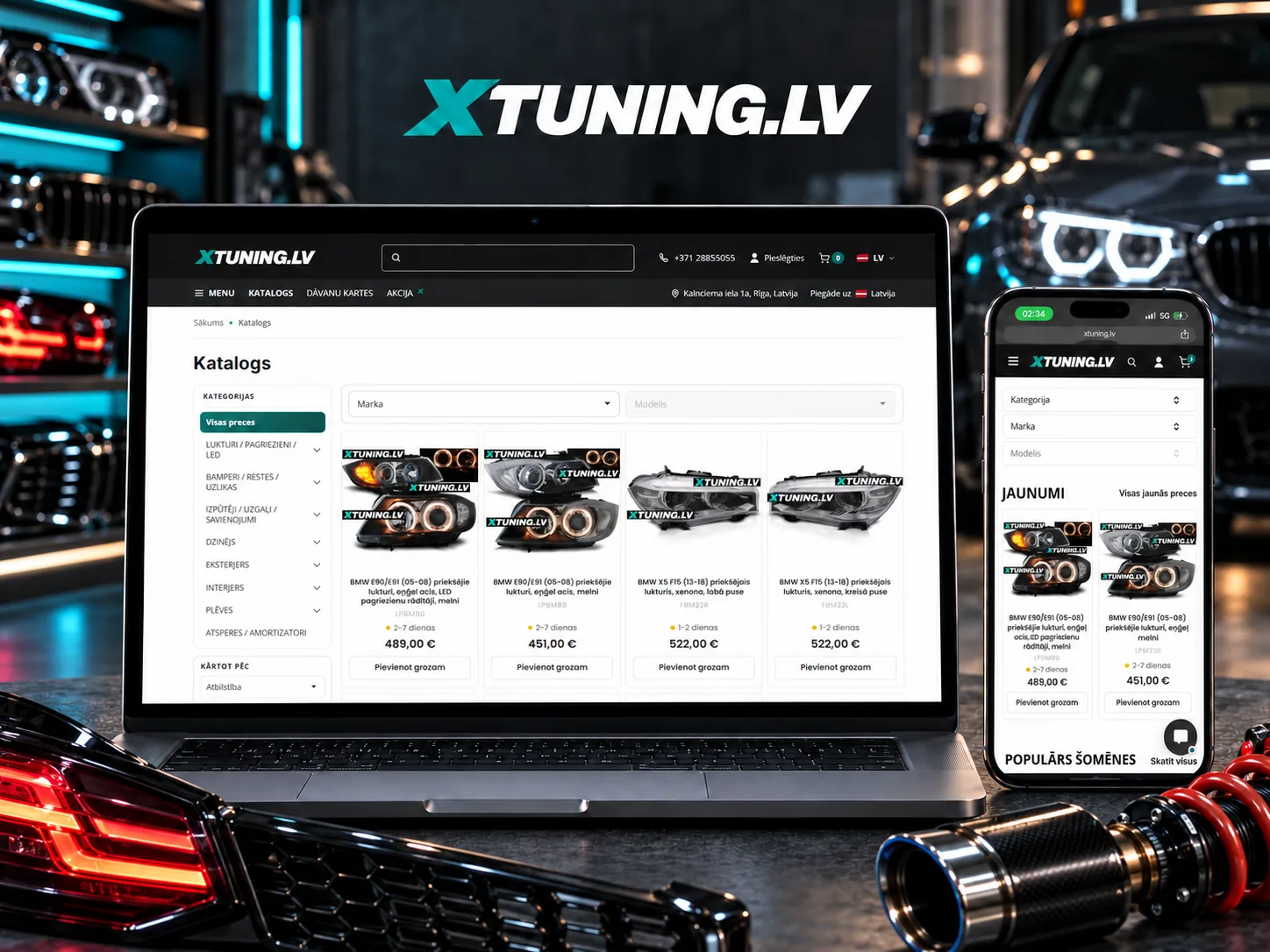
We built the new xtuning.lv online store for car tuning parts on PrestaShop: search by make and model, three languages, …

We connect AI to the systems you already use: an AI assistant on your website or online store, translation, and email and document processing with a human check.
Practical AI integration helps a business answer customers faster, prepare drafts of texts and documents, and retype less data by hand. Staff no longer have to copy information from one program to another or translate product descriptions one by one: AI does the first step, and a person makes the final decision.
KVANTS does not add AI for its own sake. We connect AI models to the systems your company already uses: your website, online store, email, CRM or accounting software. Around them we build what everyday work needs: an interface, rules, the data flow, logs and a human check.
We start with one specific routine task, test the result on your real examples and only then expand. That way you can see whether the benefit is real, and you know from the start what the running costs will depend on.
AI solutions for business are useful where people spend time on repetitive work with text, data or customer questions. AI processes a lot of information quickly, and a person checks and approves the result.
Answers to common questions about products, delivery or services right on your website or online store. A team member takes over the harder questions.
The shopper describes what they need in their own words, and the assistant finds matching products in your catalog, using only real product data.
Translations and drafts of product descriptions, categories and pages with consistent terminology. A person reviews the text before it is published.
Sorting incoming emails, a short summary and a draft reply. A team member sends the final answer.
Staff ask about procedures, price lists or contract templates and get an answer with a link to the source document.
AI helps read data from invoices, orders and PDF files and prepares it for entry into another system.
A virtual assistant, or AI chatbot for your website, answers from your own content: your pages, frequently asked questions, delivery and return terms and your product catalog. Visitors ask in their own words in Latvian, Russian or English and get an answer outside business hours too.
Unlike simple bots that follow pre-written menus, an AI assistant understands the context of a question, can ask a follow-up and, in an online store, show specific products from your catalog. If the answer is not in your content, it says so and offers to contact a person or leave a request.
Read more about how the assistant works, collects requests and hands the conversation to your team on the page «AI chatbots for websites».
Preparing and translating content takes a lot of time, especially in an online store with a large catalog. AI automation lets you create a first version of a text or translate a product description right in the admin panel. Your team only has to read it, correct it and approve publishing.
With incoming email, AI can group messages by topic, pick out the main task and prepare a draft reply. This speeds up communication with customers and reduces the risk that a request goes unnoticed.
AI is also useful in business process automation with documents: it reads company details, amounts and line items from invoices or orders and prepares them for entry into a CRM or accounting system via an API. On a review screen, a team member sees what the AI read and confirms the data. We build these connections together with our «Business process automation» and «Accounting integration» services.
People increasingly look for information and products not only on Google but also by asking AI assistants. For those assistants to read and understand your website correctly, the site needs to be technically in order.
We set up structured data (Schema.org), create an llms.txt file, set robots.txt rules for AI crawlers and help you present content with clear facts and answers to common questions. We use the same approach on our own website, where the contact forms also carry annotations for AI agents (WebMCP).
Nobody can promise that a site will appear in AI answers, but AI assistants read clearly structured content more accurately. This work fits well with SEO optimization, online stores and website development.
A real example of our work is xtuning.lv, an online store for car tuning parts that we built on PrestaShop 8 in 2026. The catalog is organized by car make, model and part type, and the store works in Latvian, English and Russian.
The store has an AI chatbot that answers shoppers' questions and shows matching product cards. The admin panel has an AI translation module that translates products, categories, CMS pages and module settings into English and Russian, and the translation can be run again.
An AI hub in the admin panel lets the store manage translations, the chatbot and SEO for all three languages in one place and see its AI spending. The store is also prepared for AI search: Schema.org structured data for products and the organization, an llms.txt file and a sitemap with Latvian, English and Russian versions.
When AI processes personal data, the GDPR applies, and responsibility for the data stays with your company. So we send the AI model only the information the task needs, anonymize data where possible, and choose services with a data processing agreement and settings under which your data is not used to train models. We limit access to what is necessary, set retention periods and, if needed, update your privacy policy.
From 2 August 2026 the EU AI Act requires that people are told when they are interacting with an AI system, such as a chatbot, unless this is obvious. We put this notice in the chat window so it is visible from the first message. The Data State Inspectorate (DVI) advises organizations to decide which AI tools staff may use and what data must not be entered into them. We can help you write simple AI-use rules. This is not legal advice; for specific cases, we recommend consulting a lawyer.
AI is not needed everywhere. If a process follows strict, fixed rules, ordinary automation without AI is faster, cheaper and more predictable, and sometimes a well-organized FAQ page is enough. We tell you this in the first conversation.
Choosing the task and the most suitable AI model
Connection to AI models via an API, with the option to switch models later
AI assistant or chatbot on your website or online store in three languages
Translation and content tools in the admin panel with human approval
Reading data from emails, invoices and documents
Integrations with your online store, CRM, email or accounting via an API
Schema.org structured data and llms.txt for AI search
Data minimization, access limits and privacy policy updates
A notice in the chat window that the user is talking to AI
AI cost overview, monitoring and user instructions
Development, design, hosting, email, maintenance — all in one place. No need to coordinate multiple vendors.
Client projects run on our servers with 24/7 monitoring. We catch issues before your visitors do.
A development plan before work starts and a fixed project price. No upfront payment for small jobs.
You talk directly to the developer, not a project manager. Faster decisions, fewer misunderstandings.
We agree on one specific routine task where AI will give the quickest and clearest benefit.
We assess what data will be processed and who will see it, and choose model providers with a data processing agreement and clear data terms.
We build a working version on your real examples and compare the result with how the work is done now.
We build the interface, connect systems via APIs and set up rules and human review steps.
We track result quality and costs, update the knowledge base and switch models when needed.
With a short conversation about your daily work. We pick one routine task, for example answering common customer questions or translating product descriptions, and prepare a written plan for a small pilot.
Current models write Latvian and Russian well enough, but quality varies with the topic and terminology. So before launch we test with your real examples in Latvian, Russian and English and adjust the instructions until the text reads naturally.
We send the AI model only the information the task needs. We choose services and settings under which your data is not used to train models and, where possible, processing in the EU. We set a retention period for conversations and documents.
AI can make mistakes, so we instruct it to answer only from your approved data and to say when it does not know. Important steps, such as publishing content or entering document data, keep a human check, and we fix errors by improving the data or instructions.
Usually not. We connect AI to your existing systems via APIs. If your online store, CRM or accounting software has an API, the data can be connected without changing the platform.
The scope depends on the task and the systems to connect. After a short conversation we prepare a written plan and quote. Using an AI model also has ongoing costs that depend on volume; we estimate them at the start.
Yes. From 2 August 2026 the EU AI Act requires that people are told they are interacting with an AI system unless this is obvious. We place the notice in the chatbot window so it is visible from the first message.
Yes. We help you write simple rules: which AI tools staff may use, for which tasks, and what data must not be entered, such as customers' personal data or trade secrets.
Projects we have built in this area.
You may also be interested in
Get in touch today for a free consultation.